
Wouldn’t it be great to be rich? Most people would like to earn big bucks and make it onto the list of the richest people on earth. A crown of gold won’t fill the hole in your heart, nor does money make you rich holistically; however, if you’re rich, people across the globe will remember you.
There seems to be a ping-pong match between tech titans every few years for the title of the richest person on earth. However, Elon Musk or Jeff Bezos is not close to being the richest man of all time despite their wealth.
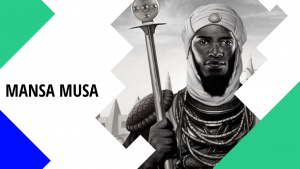
They’re still a long way from African King Mansa Musa. He is the richest individual of all time “richer than any description can describe.” How did Mansa Musa acquire such unimaginable wealth, and who was he?
Who Was Mansa Musa?
The meaning of Mansa in the indigenous language of the region is Sultan, the Mandinka, which Musa was born into in 1280.
He became king of Mali in the year 1312 and his reign of 25 years saw the country expand greatly to include nations such as Niger, Mali, Burkina Faso, Senegal, Ivory Coast, and Guinea.
In 1324, Mansa Musa made a pilgrimage to Mecca as a devout Muslim. His men carried 60,000 pounds of gold bars, while his slaves carried 12,000 pounds of gold bars each.
He made his people build mosques and madrasas in Gao and Timbuktu. Sankore Madrasah was the most famous building built during his reign.
Mansa Musa’s Rise to Riches
Musa became deputy to temporarily assume Abubakari II’s duties by the previous ruler, Abubakari II. People know this empire by its “on-call” emperors throughout its history.
This role is similar to that of a deputy leader in the modern world, as the individual would have to take control full-time if something befell the principal ruler.
In a surprising turn of events, Musa had to take charge. The day Abubakari proceeded to traverse the far region of the Atlantic Ocean, he never returned.
It wasn’t as if he appeared out of nowhere to lead. The founder of the Mali Empire was Musa’s great-uncle, Sundiata Keita.
You can attain wealth in many ways, as many late-night infomercials will inform you. Musa made his wealth fundamentally by buying and selling salt and gold, which were found in excess in Western Africa during the period. Most of his riches was spent on strengthening significant cultural centers, such as Timbuktu.
Musa didn’t become well known outside of Africa until he ventured outside of the territory he ruled, despite his massive success. In 1324, Musa, a pious Muslim, decided to do the Hajj. His name soon spread throughout the world.
Pilgrimages to Mecca continue to be important parts of Islam today. It wasn’t an easy task for Musa. His empire was over 4,000miles away. He would certainly not have been able to go alone, as he was wealthy and influential.
In total, 60,000 individuals accompanied Musa on his hajj, including attendants, fighters, and supporters.
Unlike what you would expect, Musa’s servants didn’t wear rags. The Persian silks they wore had gold staff.
Musa’s convoy of camels, horses, and people attracted the attention of the world. The caravan of Musa was not only hard to miss, he also gave off gold to random people on the street. Musa left the streets littered with gold when he moved through cities like Medina, Cairo, and Mecca.
The Cairo Impact
Musa sometimes left a large wake, however. Gold was given away so freely in Cairo that the economy was messed up for a time. The rate of gold plummeted.
As a result of Mansa Musa borrowing from Cairo lenders, the disruptions eventually settled down. Almost on his own, the king controlled the gold market at the Mediterranean. Cairo’s economy, however, did not completely recover from the golden touch of Mansa Musa until over a decade had passed.
The hajj to Mecca will undoubtedly cement Musa’s position in history. At the moment, he viewed it as a way to sanctify his conviction and to extend his kingdom. He acquired Gao in that historic journey.
Musa expanded his empire after his reign to include present-day Chad, Guinea, Mali, Senegal, Niger, Gambia, Nigeria, and Mauritania.
Mansa Musa’s Net Worth
He is estimated to have a fortune worth around $400 billion today when inflation is taken into account. Despite being rich and sultan, he was much more than that.
Mansa Musa might seem similar to other wealthy people who eventually become philanthropists, like Jeff Bezos, Elon Musk, Bill Gates, or John D. Rockefeller.
According to estimates, Mansa Musa’s net worth was around $400 billion when adjusted for inflation. John D. Rockefeller is believed by economists to have accumulated a net worth of $336 billion, the most accumulated fortune in American history.
Musa, all those centuries ago, accumulated half of the wealth of the world’s richest people as a king. Many experts regard Musa as the richest person in history. Nevertheless, many are still unable to comprehend his true wealth.
Musa’s Reign
In large part, because most experts show it during the pilgrimage to Mecca. Most people around the region had an idea about Musa’s incredible and impressive wealth.
During his reign, he sponsored an extensive construction program in Mali, raising mosques and madrasahs, including Sankore Madrasah (the University of Sankore).
In addition to encouraging urban living, he is credited with being an integral part of the emergence of urban civilization, as more and more people moved into urban centers during his time.
His Empire
During his pilgrimage, Musa also expanded his empire to include Timbuktu and Goa. During this time, with the help of Spanish and Egyptian architects, he created the Mosque of Djinguereber in Timbuktu.
Musa’s empire made Timbuktu a center of trade and culture as well as an important center for Islamic scholarship. In addition to his devotion to education, he built one of the largest libraries on earth during his reign, rivaling the Library of Alexandria with roughly 1,000,000 manuscripts.
Due to Timbuktu’s reputation, trade routes to southern European cities like Venice and Genoa included the city.